
Join our mailing list
Google Ads is a powerful pay-per-click (PPC) platform that drives qualified traffic to your website. Among its many ad formats, Responsive Search Ads stand out as the most sophisticated. Through gradual machine learning, Google tests and fine-tunes copy combinations for different search queries – ultimately directing your ad budget to the variations that perform best.
Want to learn how to save time and money with these smart ads?
Or maybe you’re just interested in the underlying mechanics?
Our Google Ads specialists are here to shed light on this game-changing ad type.
Here, we explain how Google Ads generates Responsive Search Ads for your target audience. Discover how these ads work, why they’re beneficial and top tips on how to leverage them for your next PPC campaign.
Let’s dive in!
What is a Responsive Search Ad?
Responsive Search Ads (RSAs) are dynamic Google Ads formats that pair different headlines and descriptions to tailor your message to users’ search queries. Machine learning automatically tests and identifies which combinations resonate best with your audience for relevant, impactful promotions.
Unlike traditional ads, RSAs give you flexibility without sacrificing control. Simply provide a range of approved headlines and descriptions and Google takes care of the rest.
For example, imagine you write multiple headlines like “Professional Garden Makeovers,” “Transform Your Outdoor Space,” or “Expert Lawn Care Services.” Alongside these, you add descriptions about seasonal discounts, sustainable practices, or the quality of your team’s work.
Google’s algorithms then mix and match these elements to find the top-performing combinations over time. Thanks to this smart optimisation, potential clients will see the most applicable messaging when searching for landscaping services.
RSAs also seamlessly integrate with ad extensions to boost your ads’ visibility on the search engine results page (SERP).
How Google generates Responsive Search Ads
RSAs use Google’s machine learning to adapt their content based on a user’s search intent, strengthening ad relevance. Here’s a breakdown of what this process involves:
1. Content provision: Start by giving Google Ads a pool of headlines and descriptions. These could range from enticing taglines to special deals. The more options you supply, the better.
2. Automated ad creation: Google’s AI picks, pairs and experiments with different headlines and descriptions to make personalised ads for individual search queries.
3. Combinations and filtering: The algorithm determines the most relevant ads via a scoring system, filtering out any duplicate or ineffective variations.
4. Ad auctions: Top-performing combinations are entered into real-time auctions for ad space, which is based on quality and relevance. Google usually displays at least three headlines and two descriptions in various orders to see which resonates most.
5. Continuous optimisation: Over time, Google’s machine learning algorithms analyse past search queries and performance metrics, optimising ad combinations to maximise results. That way, the most powerful message reaches the right audience at the right time.
Let’s take a look at the advantages this revolutionary approach can bring your business.
Benefits of Responsive Search Ads
RSAs are changing the game for online advertisers, allowing Google Ads campaigns to adapt and thrive with minimal manual effort. These smart ads can expand your reach, fine-tune performance, and give you a smarter way to connect with potential customers.
Here’s how RSAs can help your business grow online:
Achieve peak performance
Forget generic ads—RSAs refine your campaign by tailoring your message to fit each user’s search. They automatically adjust to show the most relevant, personalised content – putting your brand front and centre when and where it matters most.
With such dynamic and applicable content, RSAs can appear for more searches, improving visibility and reach. That means more potential customers might click on the ad and complete the desired action.
Plus, with smart machine learning, ad performance gets even better over time.
Gain more ground on SERPs
RSAs expand your ad’s footprint on SERPs, giving you extra space to catch the eye on any device.
It’s like upgrading from a small poster to a giant billboard, making sure your brand gets noticed – whether users are browsing from a desktop or scrolling on a phone.
Stay on top of search trends
The digital world never stands still, and neither should your ads. RSAs adapt in real-time to match shifting search patterns, seasonal trends, or breaking news.
Whether it’s back-to-school season or a flash summer sale, you can be confident that your prominents will stay relevant with RSAs.
Save time on testing
Stop stressing about testing separate ads for every scenario. RSAs take care of the heavy lifting by automatically mixing and matching your headlines and descriptions. It’s like having a dedicated Google Ads specialist who works around the clock.
Ramp up your Quality Score
Google loves ads that align perfectly with what users are searching for. RSAs do just that, boosting the relevance of your ads and raising your Quality Score. This can mean lower costs, better placements, and more bang for your buck.
Craft longer messages
No more squeezing your message into tight spaces. With RSAs, you’ve got room to write longer headlines and descriptions, letting you get your message across in more detail. And more words mean more chances to make an impact.
Grab attention every time
RSAs let you anchor key messages exactly where they need to be. Pin specific headlines to top spots, ensuring your most compelling statements always stand out. Think of it as crafting your ad’s “hook” to capture attention with every search.
Get actionable insights
Ever wondered what really grabs your audience’s attention?
RSAs give you the inside scoop on which combinations perform best. It’s like having a direct line to your customers’ preferences, so you can tweak, tune, and perfect your messaging for future campaigns.
How many headlines and descriptions do RSAs show?
In Google Ads, responsive search ads can feature up to three headlines (each up to 30 characters), two descriptions (up to 90 characters each), and a display URL that includes two optional 15-character path fields.
On smaller screens, like mobile devices, or when search results pages are crowded with information, fewer elements may appear.
That said, no matter the device or SERP competition, your ad will always display at least two headlines and one description.
Creating Responsive Search Ads in Google Ads
Ready to give Google’s machine learning algorithms a go?
Follow these simple steps to create an RSA in Google Ads:
1. Log in to Google Ads
a) Navigate to the Google Ads homepage and sign in with your account credentials.
2. Select a Campaign and Ad Group
a) From your dashboard, select the campaign where you want to create the RSA.
b) You can either create a new ad group or choose an existing one.
3. Create a new Responsive Search Ad
a) In the selected ad group, click the ‘+ New Ad’ button.
b) Choose ‘Responsive Search Ad’ from the dropdown menu.
4. Enter the Final URL and Display Path
a) Enter the final URL, which is the landing page where users will be directed after clicking your ad.
b) Add the display path (optional), which is part of the URL that gives users an idea of the page content, such as “yourdomain.com/dog-care.”
5. Add headlines
a) Input at least 3 headlines (up to 15). These should be unique, relevant to the ad, and optimised to match different user queries.
6. Add descriptions
a) Enter at least 2 descriptions (up to 4). These should highlight key benefits, offers, or information about your product or service.
7. Preview your ad
a) As you input headlines and descriptions, a preview of your ad will appear on the right side of the page, showing different possible combinations. Note that not all combinations may be displayed, and some elements may be shortened depending on the format.
8. Add extensions (optional)
a) You can enhance your ad by adding ad extensions such as sitelinks or a phone number, which can help improve your ad’s visibility and performance.
9. Save and launch your ad
a) Once satisfied with your ad, click the ‘Save Ad’ button to make it live.
b) Google Ads allows up to three responsive search ads per ad group, enabling its machine learning algorithms to test various combinations for optimal performance.
How do Google’s Responsive Search Ads perform?
Responsive Search Ads (RSAs) have a track record of driving results for businesses, and Google’s numbers back it up.
RSAs tend to outperform standard search ads by delivering messages that resonate with each search, leading to more relevant placements and better user engagement.
According to some Google case studies, here’s what RSAs can bring to the table:
- 96% boost in click-through rates (CTR)
- 71% increase in revenue
- 61% more conversions
- 5% higher CTR than expanded text ads
- 3,000% boost in online sales
At Redback, we’ve also seen some strong results from RSAs compared to Expanded Text Ads (ETAs):
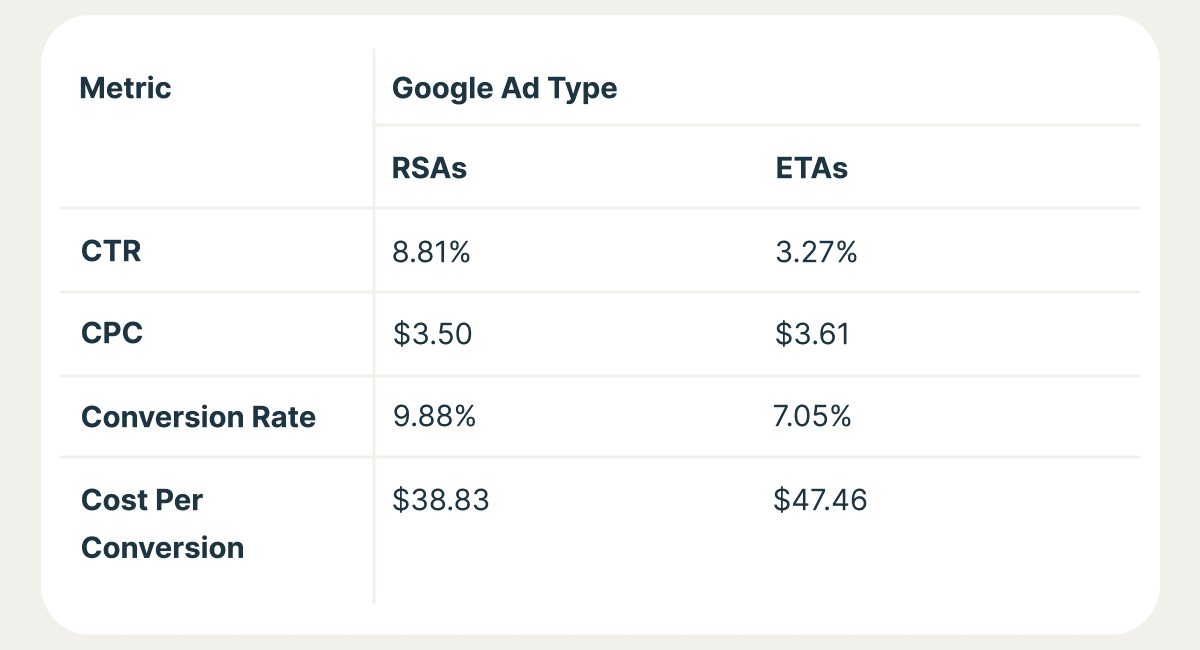
Of course, these gains aren’t guaranteed.
The magic lies in how well you optimise your ads and understand your audience.
When done right, RSAs become your campaign’s secret weapon—driving more clicks, converting at higher rates, and delivering results that make every dollar count.
Read on for tips on how to make the most of your RSAs.
Tips for Responsive Search Ads
Incorporate keywords
Weave your keywords into headlines and descriptions to make your ad stand out and match what people are searching for. Including popular search terms directly related to your product or service will increase its appeal and visibility.
Consider using Dynamic Keyword Insertion (DKI) to automatically incorporate the user’s search query into your ad. This little trick can help make your ad feel more personalised and boost its chances of getting clicked.
Also, don’t forget to keep an eye on Google’s “ad strength” rating—aim for “Good” or “Excellent” by tweaking your ad based on the suggestions provided.
Write diverse headlines and descriptions
Get your audience’s attention fast with copy that’s straight to the point. Headlines and descriptions should be sharp, interesting, and relevant to what you’re offering.
Try to include the brand name, keywords, call-to-action, and benefits in each headline.
And if there’s a discount, special offer, or unique feature, make it obvious.
When doing this, use every available slot, adding as many headline and description variations as you can. Ensure that each headline and description is different for a wider variety of ad combinations.
This gives Google more options to test and improve your ad’s performance.
Here’s an example of a best-practice headline, description and CTA:
- Brand: PeakSports
- Keyword: runners
- Benefits: waterproof and made in Australia
- Offer: 30% off
Headline: “PeakSports Waterproof Runners”
Description: “Australian made for all-weather workouts.”
CTA: “Shop now for 30%!”
Pin headlines so that they appear at the start of every RSA.
That way, you can keep key details consistently visible, no matter the search term they pop up for. For instance, pinning the brand name and main features guarantees they will be seen across all ad variations.
Add a CTA
Make sure your call-to-action (CTA) tells your audience exactly what to do next—whether it’s buying, signing up, or finding out more. Match it to the user journey, leading them straight to the product or service they’re interested in.
A good rule of thumb?
Whatever the desired action, use clear, direct words that finish the sentence “I want to….”. It also helps to add some urgency to prompt a quick response. For example, “Call Now” or “Book Today.”
You should also take advantage of Ad Customisers, which automatically update your ad with details like sale countdowns or stock levels, making your message extra relevant and timely.
Another great tool is IF Functions. With this feature, you can adjust ads based on factors like the user’s device or audience type. This helps you deliver a CTA message that resonates with different consumers.
Test, test, test
Don’t just launch your Responsive Search Ads and rely on Google to optimise them. While machine learning will refine RSAs over time, it still pays to stay on top of performance and make manual tweaks where needed.
Watch your metrics closely. Dig into the data—click-through rates, conversion rates, cost-per-acquisition—anything that gives you a clear picture of what’s working and what isn’t. When you find weak spots, don’t hesitate to make bold copy changes.
For instance, run your own A/B tests to compare headline, description, and CTA variations to uncover the elements that get people to act. This testing isn’t a one-time thing; it’s an ongoing process that separates good ads from great ones.
Get the most out of your Google Ads with Redback
RSAs have revolutionised PPC advertising, making it easier to deliver relevant messages to more potential customers and boost campaign results. By utilising Google’s machine learning to adapt ad combinations on the fly, this ad format helps maximise clicks and conversions with less manual effort.
Plus, incorporating smart strategies like keyword inclusion, pinning important details, and using Dynamic Keyword Insertion can help your ads deliver an even stronger return on investment.
That said, even if you know how Google generates Responsive Search Ads, staying on top of PPC activity can still be a complex task. From copywriting to campaign builds and data analysis, there’s still a lot to do. That’s where professional Google Ads specialists, like the team at Redback, come in.
Equipped with years of hands-on experience, we can handle all the intricacies of Google Ads setup, testing, and optimisation. As Newcastle’s longest-standing Google Premier Partner, we’ll make sure your business takes full advantage of its latest capabilities, freeing you up to focus on core tasks.
For start-to-finish support with Google Ads, give us a call at (02) 4962 2236 or enquire online today.
New project to discuss? Need reliable support? Complete our quick enquiry form and we'll be in touch!
- What is a Responsive Search Ad?
- How Google generates Responsive Search Ads
- Benefits of Responsive Search Ads
- How many headlines and descriptions do RSAs show?
- Creating Responsive Search Ads in Google Ads
- How do Google’s Responsive Search Ads perform?
- Tips for Responsive Search Ads
- Get the most out of your Google Ads with Redback