Google’s latest leap into artificial intelligence is already rewriting the rules of search.
AI Overviews – the smart summaries at the very top of Google Search – are transforming how people discover and consume information online. Instead of typing keyword phrases, people are asking questions in everyday language and getting instant answers without having to click any links.
For businesses, this means less direct traffic, new SEO challenges, and shifts in brand visibility. But it also opens the door for websites with rich, useful and digestible content to feature as trusted sources and gain more qualified leads.
In this guide, our SEO specialists break down what AI Overviews mean for Australian businesses and how you can adapt your strategy to stay competitive in 2025.
What are AI Overviews?
AI Overviews are Google’s AI-generated summaries that appear at the top of search results, providing quick, direct answers to user questions.
Instead of only showing a list of blue links, Google uses artificial intelligence to compile information from top-ranking website pages and present it in a single, easy-to-read snapshot.
Here’s an AI Overview example:
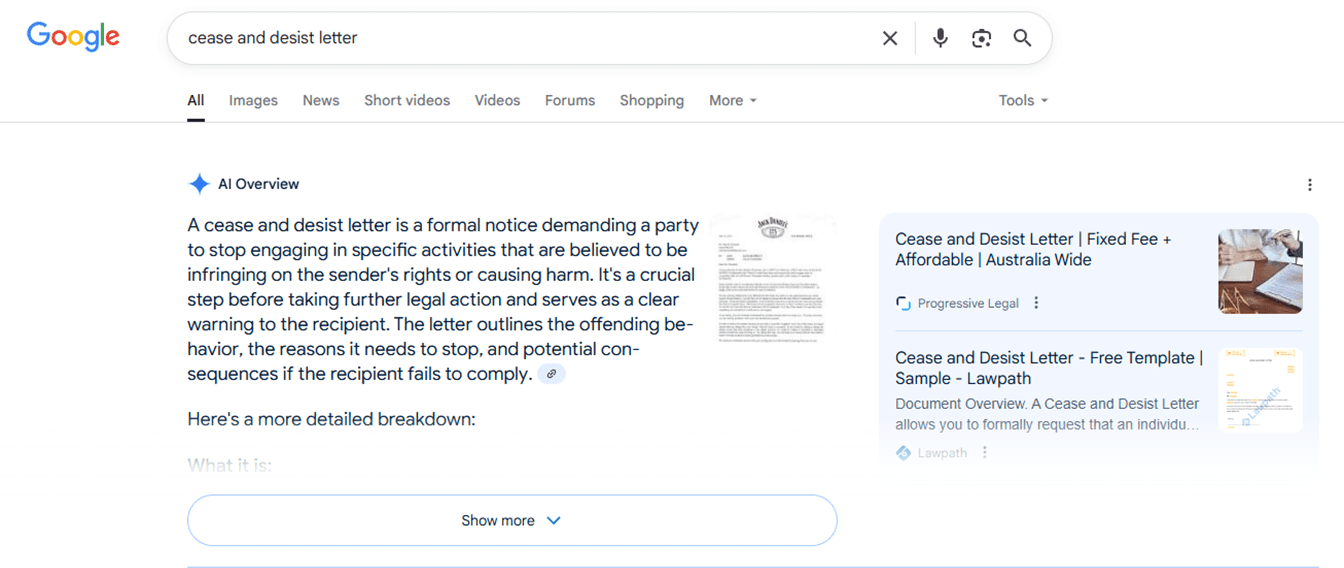
Google released AI Overviews in Australia in October 2024, following their May 2024 rollout in America.
How do AI Overviews work?
Traditional search engines rank web pages based on dozens of signals like content quality, backlinks, site speed, and how well the page matches your intent. That’s why results are stacked in order, and you decide which one to click.
Google AI Overviews cuts through that process.
The first major integration of generative AI into mainstream search, this feature reads and interprets information from across the web, synthesises relevant insights, and delivers one short, easy-to-understand summary.
This is made possible by Google’s Gemini model, which brings together:
- Multi-step reasoning that breaks down complex queries into digestible answers.
- Planning and problem-solving for tasks like trip planning or comparing products.
- Multimodality to work with different types of information, from text to images.
That means you can ask Google more conversational, open-ended, or complex questions, and get a clear and comprehensive AI-generated answer.
How AI Overviews impact SEO
AI Overviews have a major impact on SEO. These answers are changing how people interact with search results. Here are some potential effects of AI Overviews on your website’s organic visibility and performance:
Fewer clicks
When AI Overviews answer simple questions directly, users who just want a quick fact don’t need to visit a website. This means informational, top-of-funnel content is seeing lower click-through rates.
For example, a position one result that once attracted around 39% of clicks now averages closer to 23% when an AI Overview is present. Naturally, this leads to a drop in organic traffic.
But fewer clicks don’t automatically mean worse performance.
Higher conversion rate
The traffic you do receive from AI Overviews is typically more qualified.
That’s because users clicking through have already had their basic questions answered and are now looking for deeper solutions or trusted providers of goods and service, while cutting out users who just wanted a quick answer to a question and were unlikely to go any further.
Even better, if your brand is cited as a source within an AI Overview, Google effectively endorses your expertise. This builds trust before the user even lands on your site, making them more confident and more likely to convert.
In other words, Google’s AI acts like a pre-qualifier, sending you fewer, but far more valuable, visitors who are further along in their buying journey.
More impressions
While clicks may fall, impressions can rise. AI Overviews draw from multiple sources to build an answer, so your content has more chances to be seen, even if it’s not the top-ranking result.
If your content is authoritative, well-structured, and genuinely useful, it could be pulled into these AI-generated summaries — putting your brand in front of searchers at the very top of Google. This expanded visibility means more brand recognition, more trust, and new opportunities to capture traffic that traditional search alone may not have delivered.
SEO for AI Overviews: 8 key steps to showing up on search
Google’s AI Overviews now sit above the standard search results, which means businesses need to think about SEO a little differently. The basics still matter — fast websites, helpful content, and strong technical performance — but you also need to make sure your content is easy for AI to understand and worth citing.
That makes the path to success twofold: build a solid SEO foundation to rank in the top 10, then adapt your content for Google’s AI so it’s more likely to be featured.
Here’s how to show up in AI overviews and Search Engine Results Pages (SERPs):
Tick all the technical SEO boxes
If your website isn’t crawlable, fast, and mobile-friendly, your SEO efforts won’t get far. Google’s AI evaluates not just content, but also how people interact with your site, so user experience (UX) is still a major ranking factor.
Technical essentials for SEO and AI visibility:
- Design with mobile responsiveness first, ensuring a smooth experience on any device.
- Use HTTPS for security and trust.
- Maintain clean, logical URL structures and up-to-date XML sitemaps.
- Add schema markup (FAQ, LocalBusiness, Product) to give Google extra context.
- Keep Core Web Vitals in the green, especially on mobile.
Pro tip: Use tools like Hotjar, Mouseflow or Microsoft Clarity to see how visitors navigate your site. Analysing scroll depth, clicks, and engagement patterns can highlight where improvements are needed, helping you refine your optimisation strategy with real data.
Ultimately, a technically sound, user-friendly website creates the foundation for strong rankings, higher engagement, and visibility in Google’s AI-driven search results.
Weave in the right keywords
To see a real return on investment, businesses need to focus on the right keywords and create content that uses them in a natural, meaningful way:
- Explore related topics: Instead of locking onto one phrase, research the broader questions your audience is asking. Platforms like TikTok and Reddit can reveal trending conversations and give you ideas for content that feels authentic.
- Add keywords organically: Write your content first, then blend keywords where they fit. If a phrase feels forced, it weakens the copy. Quality, clarity, and usefulness matter more than a perfect keyword score.
- Avoid stuffing: SEO tools can flag when you’re repeating a keyword too often. Over-optimisation not only turns readers away but also makes it less likely your content will be selected for AI summaries.
Remember, keywords should guide your content, not control it. When used in context, they strengthen your authority and help your site rank, without sacrificing readability.
Align with search intent
Google’s AI Overviews are designed to give users the most complete answer possible, which means your content needs to match search intent.
Instead of only targeting keywords, you should focus on understanding why someone is searching and delivering content that fully answers their question.
Tools like Google Search Console, keyword research platforms, and even analysing “People Also Ask” results can help reveal what users really want to know.
By tailoring your content around these insights, you boost your chances of being selected by AI as a trusted source.
Here’s how to align with search intent:
- Study existing AI Overviews for your target queries to see what formats Google is using.
- Note the structure – is the answer framed as a how-to, a definition, a comparison, or a local result?
- Take inspiration from the format while adding unique insights or examples that make your content stand out.
- Sprinkle “People Also Ask” questions into your page to cover related intent.
If your content matches what users are really looking for — not just what they type — Google’s AI is far more likely to showcase it.
Build authority with quality content
AI has made it much harder to cut corners with SEO. In the past, tactics like keyword stuffing, thin content, or link schemes could artificially boost rankings.
Today, Google’s AI is far better at recognising patterns. It can tell the difference between genuine expertise and low-quality content with no regard for actual human readers.
This is why Google’s ranking systems place such heavy emphasis on E-E-A-T: Experience, Expertise, Authoritativeness, and Trustworthiness.
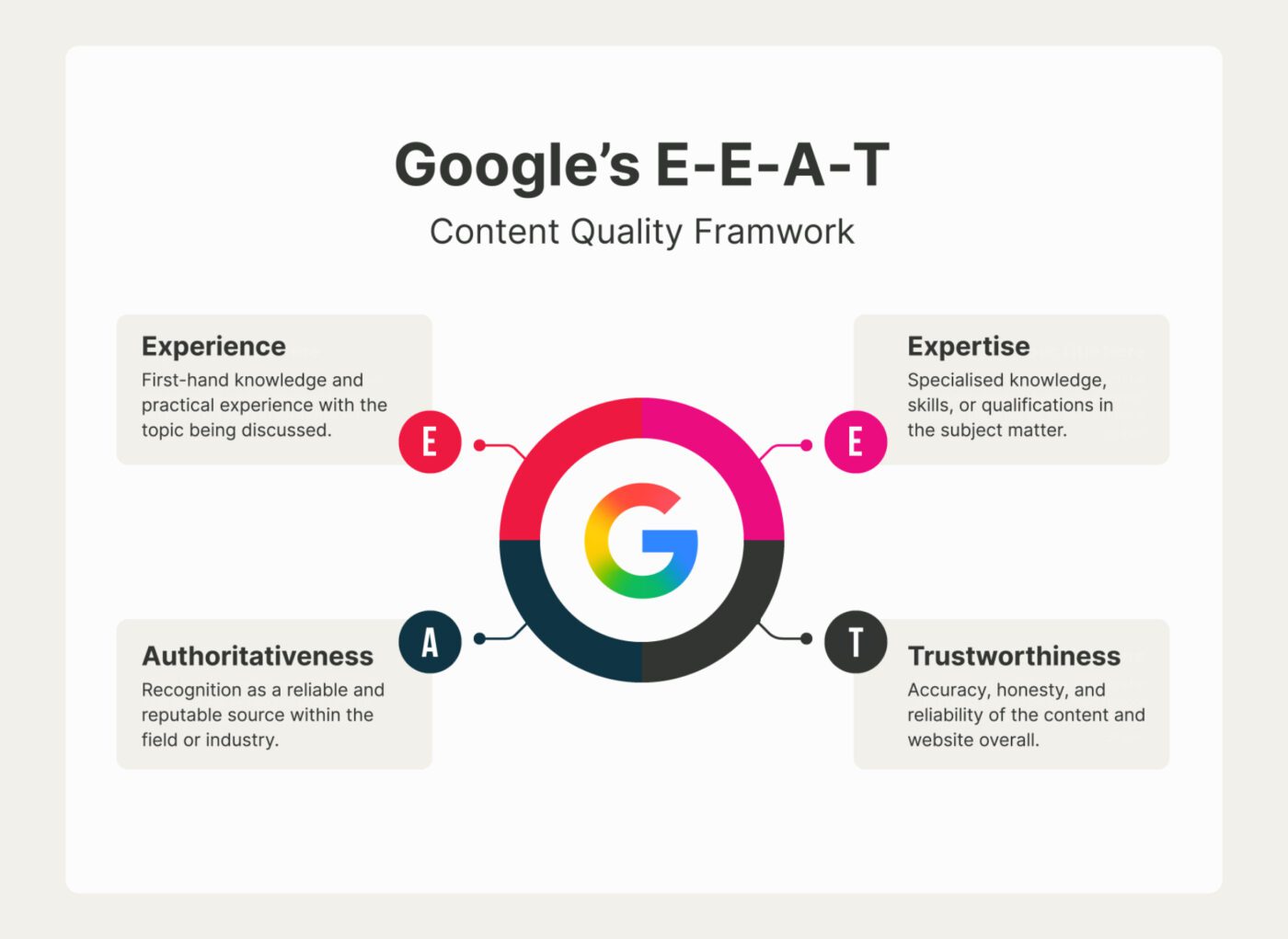
Businesses that consistently demonstrate these qualities are far more likely to be cited in AI Overviews and other rich results.
That makes optimising content for AI appearances similar to traditional SEO techniques:
- Write detailed author bios that showcase real expertise and credentials.
- Share case studies and real-world examples from Australian clients.
- Highlight local accreditations and industry memberships on your site.
- Use trusted references, linking to .gov.au or .edu.au sources where relevant.
- Keep content fresh with regular updates (ideally every quarter).
- Publish in-depth, useful and unique blogs that tackle user questions thoroughly.
- Offer downloadable resources (guides, checklists, whitepapers) and highlight them in meta
- descriptions to encourage click-throughs.
- Format content clearly with lists, FAQs, and concise explanations to make it easy for both users and AI to extract key points.
High-quality, well-structured content improves visibility in AI Overviews and builds long-term trust with your audience. With zero-click searches becoming more common, users may find answers without leaving Google, so the goal is to be visible where the answers appear.
If your content demonstrates real expertise and provides more value than a quick AI summary, Google is more likely to showcase your brand as the trusted source.
Informational (blog) content still plays an essential role in any successful SEO strategy. They build the “E.E.A.T” of your site, provide backlink targets, and get your business name front of mind for any users still in the research stage of their buyer journey. However, direct traffic to these pages will drop.
Structure content for AI
Google’s AI likes content that’s simple, skimmable, and well-structured. In fact, most AI Overviews highlight lists or clearly organised answers because they’re quicker for users to digest.
Here’s how to make your content AI-friendly:
- Use clear headings (H2/H3): Break up your page into sections that directly answer common questions.
- Make the most of lists: Step-by-step instructions or quick comparisons work best in bullet points or numbered lists.
- Add FAQs with schema: This helps Google recognise your content as a good fit for AI summaries.
- Use tables for comparisons: Data like pricing, features, or service options is much easier for AI (and users) to understand in table format.
Summarise key points: Include short recap boxes or highlighted sections for complex topics.
With these best practices in place, your content is more likely to be picked up by Google’s AI — and more enjoyable for people to read, too.
Optimise for local AI
With more than two-thirds of local searches now triggering AI-powered results, Australian businesses need to strengthen their local SEO signals to stay visible.
Google’s AI looks for consistent, trustworthy data when deciding which businesses to include in local responses, so accuracy and relevance are key.
Follow these steps for local AI optimisation:
- Complete your Google Business Profile – Make sure every field is filled out, including services, opening hours, and photos.
- Keep NAP details consistent – Your business name, address, and phone number should match exactly across all Australian directories.
- Encourage detailed reviews – Ask customers to mention specific services or suburbs in their reviews, as this helps AI match your business to local queries.
- Create location pages – Build landing pages for key cities, suburbs, or service areas you operate in.
- List on trusted directories – Add your business to platforms like Yellow Pages, Localsearch and relevant industry directories.
By actioning the above, you’ll make it easy for Google to verify who you are, where you operate, and what you offer.
Build authority across your online presence
Google’s AI doesn’t just scan your website; it pulls from the entire ecosystem of content linked to your brand. Instead, it needs to build authority across multiple platforms. The stronger and more consistent your digital footprint, the more likely you are to be cited in AI Overviews.
So to succeed in the AI era, your SEO strategy can’t rely on articles alone. Rather than being just a supplementary component of your digital marketing retainer, your SEO strategy needs to evolve from regular blogs into a dedicated, personalised campaign that seeks to maximise organic conversions.
Here are some ways to strengthen cross-platform authority:
- Align paid and organic efforts – Run Google Ads campaigns that reinforce the same topics you target in SEO.
- Leverage YouTube – Publish videos that expand on your main website content to capture both search and video visibility.
- Join the conversation – Engage on platforms like Reddit and Quora, where Google increasingly sources information.
- Keep messaging consistent – Ensure your brand voice and expertise are clear across all touchpoints, from social media to ads.
By spreading your authority across channels, you’re not only improving SEO performance but also showing Google’s AI that your business is a credible, multi-dimensional source of information.
Adjust SEO strategies as algorithms change
Google’s algorithms are constantly changing, especially as AI becomes more central to search. To stay visible online, your SEO strategy needs to evolve with them.
The key is to stay informed and proactive:
- Follow trusted sources like Google’s official blogs for updates on ranking changes.
- Set up alerts for major SEO news so you can react quickly rather than playing catch-up.
- Review and adapt your content strategy regularly to prevent sudden drops in visibility.
AI Overview tracking
As AI features like AI Overviews roll out, it’s no longer enough to measure rankings and clicks alone.
Businesses need new ways to measure visibility, authority, and the quality of traffic your content generates.
That means adjusting your focus from:
- Traffic volume to visitor quality and engagement.
- Individual page rankings to topical authority across clusters of content.
- Keyword density to comprehensive coverage of related topics.
- Position tracking to overall visibility within AI-influenced SERPs.
Thankfully, you can use several tools to keep track of performance. Here are just a few examples:
- Search Console: Clicks from AI Overviews are included in your overall Web search traffic and appear in the Performance report. This makes it possible to monitor impressions, clicks, and changes in visibility as AI summaries become more common.
- Google Analytics: Once a user clicks through, you can track engagement metrics such as time on site, conversions, and bounce rates.
- Hall: A dedicated tool for website owners to understand and measure how they appear across Google AI Overviews and other conversational AI platforms.
At Redback, we’ve developed our own visualisations to track traffic and conversions coming from AI sources. Clients get a dedicated page of their digital marketing dashboards in Looker Studio that gives a clear overview of AI performance.
Google AI Overview FAQs
Google’s core goal is to remove obstacles between people and the information they need. AI Overviews were introduced to make searching faster, easier, and more useful.
The purpose of AI Overviews is to:
- Make complex topics easier to understand by presenting the key points in plain language.
- Save time by answering questions that might normally require several searches.
- Show a wider variety of sources, giving visibility to publishers, businesses, and creators.
Instead of scanning through multiple links, users get a clear answer straight away, with the option to click through for more detail if they want to learn more.
AI Overviews are triggered when you type a search query that Google recognises as needing more than a quick fact, usually an informational or educational question.
AI Overviews are most likely to appear when your query involves:
- Explanations of specific topics – e.g. “What is renewable energy?”
- Step-by-step or “how-to” instructions – e.g. “How do I remove coffee stains from clothes?”
- Comparisons – e.g. “iPhone vs Samsung for battery life.”
- Definitions and clarifications – e.g. “What does topical authority mean in SEO?”
- Complex, multi-angle questions – e.g. “How can my business rank higher on Google in Australia?”
Ultimately, Google says AI Overviews only appear when its systems are confident the generative AI response will add real value beyond a standard search. As opposed to just showing a list of links, these answers combine useful information from multiple trusted sources.
AI Overviews can be useful, but they’re not always spot-on.
When AI Overviews first launched in 2024, some of the answers raised eyebrows. One suggested people should “eat one small rock per day,” while another claimed glue was a good way to keep cheese on pizza.
Although providing some comic relief, these examples show the bigger issue: AI can’t tell the difference between fact and parody like a human can. It doesn’t “understand” truth — it predicts what looks like the most likely answer based on patterns in data. And these predictions aren’t always correct.
Here’s the reality of how accurate AI Overviews are:
- The good: They’re quick, they simplify complex topics, and they usually provide links so you can check the information yourself.
- The bad: They sometimes misinterpret language, reference sources that don’t back up the claim, or produce answers that sound confident but are completely wrong.
Moreover, as Google begins to integrate ads into AI Overviews, some worry this could blur the line between accurate information and paid promotion.
While Google has introduced guardrails, quality checks, and policies to limit harmful or misleading information from showing up, these measures aren’t fail-safe yet.
At the end of the day, AI Overviews are best used as a starting point, not the final word. If the answer really matters, click through to the sources and make sure the details stack up.
Get started with an AI Channel Audit
Google AI Overviews are already reshaping how people search, and the impact on traffic and conversions will only grow. For Australian businesses, the question isn’t “Will AI will affect my visibility?”; it’s “By how much?”. Understanding these changes now will give you the edge to adapt before competitors do.
If you want to see exactly how AI is influencing your website performance, Redback can help. Our AI Channel Audit provides a detailed analysis of how AI-driven search is affecting your traffic, rankings, and conversions — and where the opportunities lie.
Call us on (02) 4962 2236 or send an enquiry online to keep your business ahead in the age of AI.
New project to discuss? Complete our quick enquiry form and we'll be in touch!
